Cashly-Play & Earn in Minutes
- 4.3
- Rating
- 100.00K
- Installs
- Free
- Price
 Analysis by App-foxy
I approached Cashly-Play & Earn in Minutes as a small, practical way to fill spare moments rather than as a replacement for a job or a serious income source. It belongs to the lifestyle category, is free to use, and comes from Money Rewards LLC. The central idea is simple: open the app, choose from the available play opportunities, spend time with them, and work toward real rewards. That sounds straightforward, but the useful question is what the complete journey feels like from the first tap to the point where a reward becomes meaningful.
My overall impression is that Cashly is best suited to someone who already enjoys casual mobile games and would rather receive something back for that downtime. It is less convincing for anyone who wants predictable earnings, deep game design, or a clearly structured financial tool. The difference matters. The app can make idle minutes feel more purposeful, but the value depends heavily on how consistently you play and how much patience you have with the reward process.
From an empty few minutes to a usable reward
I look at the gap between opening Cashly and getting something useful from a session, because the reward idea only works when the steps feel worth the time. I’ll focus on how to set a sensible pace, notice whether progress is being recorded, and decide when a short play break has done enough. That practical rhythm leads naturally to the question of what to expect from those first few minutes.
You May Also Like

 Blood Strike: 2.5 Anniversary
Blood Strike’s Loadouts Turn Every Drop Into a Tactical Gamble
A close look at Blood Strike’s custom loadouts: how fast access to signature weapons reshapes its battle royale rhythm, rewards preparation, and narrows the gap between fights.

 Pandora - Music & Podcasts
Pandora’s Music Is Easy to Start, but Harder to Recover
Pandora’s strength is its low-effort path from a seed to a station. Its weak spot is how much confidence it asks you to place in connection, setup, and quiet recovery.

 8 Ball Pool
 Is Built on Rivalries, Rematches, and Routine
A close look at the rivalries, rematches, shared routines, and unanswered safety questions that turn a quick pool match into a persistent mobile community.

 Samsung Music
’s Quiet Strength Is Playing What You Already Own
Its reach comes less from spectacle than from dependable access to a personal library. That simplicity is both the app’s strongest retention engine and its ceiling.

 AccuWeather: Weather Radar
AccuWeather Review: A Quick, Clear Forecast for Everyday Decisions
For everyday plans, the best forecast is the one you can understand quickly. AccuWeather makes rain timing, radar, and local conditions easy to act on, with a few trade-offs.

 Hill Climb Racing
Why Hill Climb Racing Still Turns Crashes Into One More Run
A tiny car, a bumpy hill and one more upgrade: Hill Climb Racing keeps resurfacing because its simple chaos makes every near-miss feel personal.
More From Our News Desk
View All News


What I would expect before installing
The starting condition is familiar: I have a short break, my usual entertainment apps are already open, and I want something light that does not require a long commitment. Cashly fits that situation better than a traditional budgeting app or a dedicated banking service because its main activity is play. It is aimed at adults and younger users alike, with an Everyone content rating, so the presentation is designed to be broadly approachable rather than specialized.
The app has reached over 100 thousand installs and holds a 4.3 average from around 4.5 thousand ratings, with roughly 1.1 thousand written reviews. Those figures suggest that Cashly has attracted a real audience, although they should not be mistaken for proof that every user will have the same reward experience. A reward app can be enjoyable for one person and frustrating for another depending on available time, game preferences, and expectations.
Installation is free, which removes the most obvious barrier to trying it. I would still treat “free” as a reason to test the workflow carefully, not as a promise of effortless money. The important personal calculation is whether the time spent playing feels worthwhile even when the reward is modest. If the answer is no, the app will probably feel like work disguised as entertainment.
The first session and the importance of a low-pressure start
On a first visit, I would avoid rushing through every available option. A better approach is to look at the selection, choose one activity that genuinely seems enjoyable, and observe how the app handles progress before investing a long session. This is one of the less obvious advantages of starting slowly: it lets me judge whether the play experience itself is pleasant, rather than allowing the reward promise to make an ordinary game feel more exciting than it really is.
I would also begin with a short, defined session. For example, a few minutes during a commute wait or while the kettle is boiling gives me enough time to understand the basic rhythm without turning the first test into a commitment. Cashly’s appeal depends on repetition, so learning the routine matters more than trying to maximize the first visit.
The developer, Money Rewards LLC, positions the product around playing and earning, but I would keep my own notes about what I do inside the app. That does not need to be complicated. I would remember which activity I selected, whether progress appeared clearly, and whether moving from play to reward information felt obvious. These small observations answer practical questions faster than a store description can.
A step-by-step workflow that makes sense
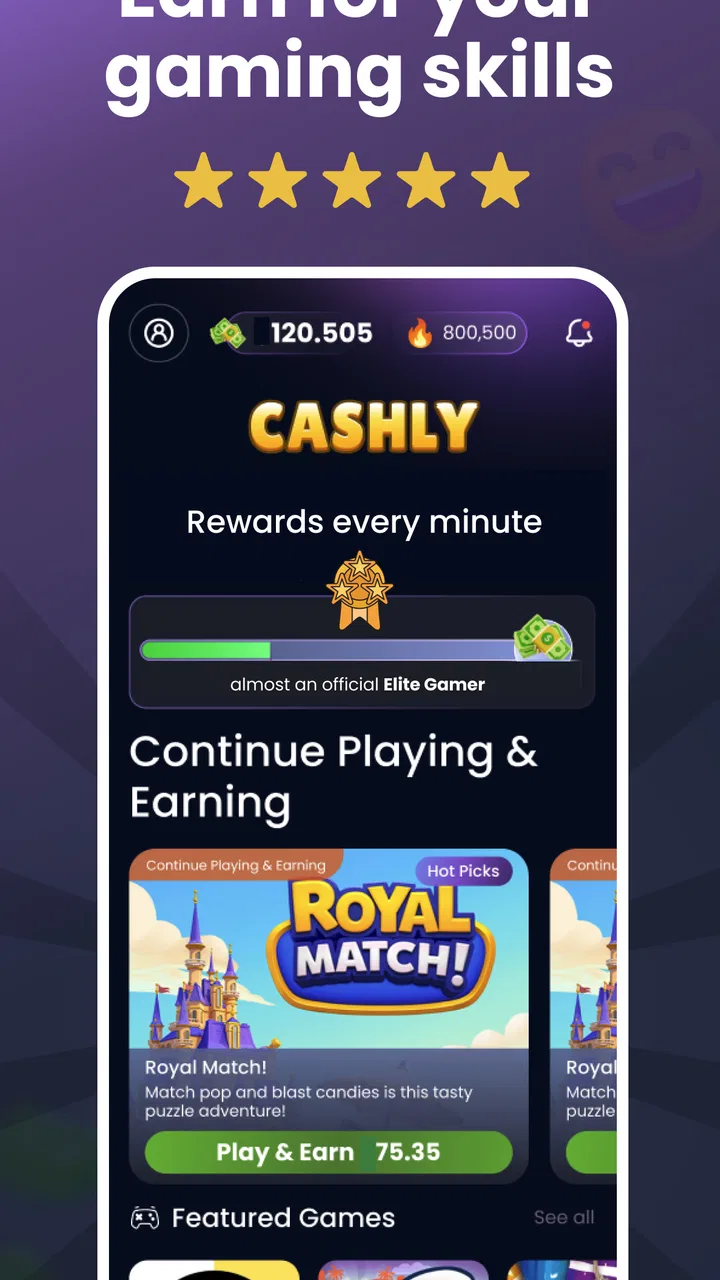
My recommended workflow begins with choosing an activity that matches the time available. If I have only a short break, I would avoid anything that seems to require a long uninterrupted session. If I have more time, I can explore further, but I would still check the progress indicators before assuming that every minute has the same value. The store summary emphasizes earning while playing, yet a careful user should not interpret that as a guaranteed fixed return for every minute.
Next comes the actual play. This is where Cashly differs from survey and cashback alternatives. Instead of answering questions about purchases or scanning receipts, I am spending time inside a game-like experience. That can make the process less tedious, especially for someone who already reaches for casual games at the end of the day. The trade-off is that entertainment value becomes part of the calculation: if the activity is repetitive, the reward may not compensate for the boredom.
After playing, I would review the progress or reward area before closing the app. This handoff is easy to overlook. A user may assume that simply opening a game is enough, while the practical experience depends on understanding how activity is reflected in the account. Checking the result after each early session helps identify whether the app is recording progress in a way I can follow.
Then I would continue only if the exchange feels reasonable. My rule would be simple: play because the activity is at least mildly enjoyable, and treat the reward as an extra benefit. That mindset protects the experience from becoming frustrating. It also makes Cashly more suitable for spare-time use than for planned earnings targets.
Where the handoffs create friction
The first handoff is from browsing to playing. A casual game can make this transition feel natural, but an earning app also creates a second layer of attention because I am watching for progress. That split focus may reduce the fun. I found that the best way to handle it is to decide in advance whether a session is primarily for entertainment or primarily for testing the reward flow. Trying to do both intensely can make every pause feel like lost value.
The second handoff is from completed activity to reward tracking. This is the point where expectations need to stay realistic. A reward balance is not the same as money already available for spending. It represents progress within the app, and the user still needs to follow the app’s own redemption path. I would therefore avoid mentally counting a reward as part of my budget until the process has actually finished.
The third handoff is from the app to everyday use. If I am playing during a lunch break, I need to be able to stop without feeling that I have abandoned something important. A good routine is to end at a natural pause, review the recorded progress, and return later rather than forcing an unnecessarily long session. This is especially useful for people who use Cashly in several short windows throughout the day.
Another practical consideration is device compatibility. Cashly lists a minimum operating system of version 12, so anyone using an older phone or tablet should check compatibility before planning around it. The current version is 1.12.057, which is useful to know when troubleshooting installation or behavior. Keeping the app updated can also reduce confusion when the interface changes, although updates do not automatically make the reward experience more valuable.
How the outcome compares with familiar alternatives
Compared with survey apps, Cashly replaces answering questions with gameplay. That is a meaningful difference for people who dislike repetitive questionnaires, but it also means the time commitment may feel less predictable. A survey has a clear beginning and end; playing can continue indefinitely, which makes it easier to lose track of time.
Compared with receipt or cashback services, Cashly does not fit naturally into a shopping routine. Receipt apps reward an action I was already going to take, such as buying groceries. Cashly asks me to spend time inside its entertainment flow. For that reason, a cashback service is usually the better choice if I want rewards attached to existing purchases, while Cashly is more relevant when I want an activity for otherwise empty minutes.
Compared with ordinary free games, the reward angle is the main distinction. A normal casual game may offer progression, challenge, or collection without any expectation of a real-world benefit. Cashly adds a reason to keep returning, but that reason can also make a simple game feel transactional. I would choose a regular game instead when I care more about polished gameplay than about earning something small in the background.
Compared with budgeting tools, Cashly serves a completely different purpose. It may support a little motivation during downtime, but it does not replace expense tracking, saving plans, or financial education. Someone trying to control spending should use a proper finance app and regard Cashly, at most, as a separate leisure activity.
Who gets the most from the workflow
The strongest use case is a person who already plays casual mobile games and has several short periods of unplanned downtime. Waiting for an appointment, taking a quiet break, or relaxing before bed can become a repeatable routine. In that scenario, the app does not need to transform the day; it only needs to make an existing habit feel slightly more rewarding.
A realistic example would be a commuter who has ten minutes before a train arrives. Instead of opening a social feed, the user starts Cashly, selects a suitable activity, plays until the train is ready, and checks the recorded progress before putting the phone away. Later, another short session adds to the same routine. The benefit is not a dramatic payout; it is that the user has replaced aimless scrolling with an activity that may produce a reward over time.
It can also suit someone who wants a low-stakes introduction to reward apps. Because the app is free and rated for Everyone, the initial barrier is relatively low. Still, I would explain the process to younger users and encourage sensible screen-time limits. The reward concept should never become a reason to keep playing longer than planned.
Cashly is a weaker match for users who need dependable income, dislike mobile games, or become anxious when progress is slow. It is also not ideal for someone who wants a single, clearly defined task followed by an immediate result. In those cases, a receipt service, a survey with transparent completion terms, or simply a conventional game may be less frustrating.
Small habits that improve the experience
My first tip is to separate testing from routine use. During the first few sessions, pay attention to how play becomes recorded and how the reward area presents progress. Once that feels understandable, use the app casually. This prevents a user from spending a week on assumptions about how the system works.
My second tip is to set a time boundary before opening it. A timer or a natural stopping point keeps the reward from taking over the session. This is a real trade-off: the app encourages continued play, but the value of a reward falls if the user sacrifices sleep, work, or other priorities to pursue it.
My third tip is to compare the experience with what I would otherwise do. If Cashly replaces ten minutes of pointless scrolling, it may feel worthwhile. If it replaces a hobby I genuinely enjoy or a task that earns more value, the calculation changes. The right benchmark is not another reward app alone; it is the best alternative use of that same time.
My fourth tip is to keep expectations tied to entertainment rather than arithmetic. Even though the store summary highlights earning while playing, I would not plan a purchase around a projected balance. Treating rewards as a bonus makes the app easier to enjoy and reduces disappointment when a session feels slower than expected.
Where the flow breaks down
The main weakness is the tension between play and productivity. The app may make downtime feel useful, but it can also encourage users to judge every minute by its reward potential. That is not a problem for everyone, yet it can make casual entertainment feel pressured. If I notice myself continuing only because I feel I have already invested time, I would close the app rather than chase the next milestone.
Another possible source of friction is the gap between visible progress and a finished reward. Users naturally want a clear connection between what they did and what they can use. Any extra step in that handoff can make the process feel less immediate than ordinary gameplay. I would approach the reward section patiently and read each screen rather than tapping quickly through it.
The app also depends on having a compatible device and enough tolerance for casual repetition. The operating-system requirement can exclude older hardware, while people with limited storage, battery, or screen time may prefer lighter alternatives. These are not reasons to dismiss Cashly, but they are important before making it part of a daily routine.
My final assessment
Cashly-Play & Earn in Minutes is an approachable lifestyle app for turning spare gaming time into progress toward real rewards. I like the basic exchange because it gives casual play a practical angle without requiring a purchase to begin. Its free price and broad age rating make it easy to try, and its audience size and 4.3 average indicate that many users find the concept appealing.
My recommendation comes with a clear condition: use it as entertainment first and rewards second. The app is a good fit when you already enjoy casual games, have small pockets of free time, and can accept that the outcome may build gradually. It is not the right choice if you need predictable earnings, immediate cash, or a more transparent task-and-payment structure.
In the end, the best result comes from a modest workflow: choose a suitable activity, play within a planned time limit, check that progress has transferred correctly, and continue only when the experience still feels enjoyable. Cashly works best as a bonus attached to downtime, not as a substitute for reliable income. That distinction makes the app easier to judge honestly and helps the right users get something useful from it without expecting more than casual reward gaming can realistically provide.
FAQs for Cashly-Play & Earn in Minutes
01What is Cashly-Play & Earn in Minutes?
Cashly-Play & Earn in Minutes is a mobile application available for both Android and iOS platforms. It allows users to earn rewards by playing games, completing surveys, and engaging with various tasks. The app is designed to provide a fun and rewarding experience, making it easy for users to earn money in their spare time.
02How do users earn rewards on Cashly?
Users can earn rewards on Cashly by engaging in different activities such as playing games, watching videos, and completing surveys. Each task has its own reward value, and users can accumulate points which can later be redeemed for cash or gift cards. The app provides a seamless experience to track progress and manage earnings.
03Is Cashly-Play & Earn in Minutes free to use?
Yes, Cashly-Play & Earn in Minutes is free to download and use. However, users may encounter optional in-app purchases or advertisements. These are designed to enhance the user experience by providing additional opportunities to earn or access premium features, though they are not necessary to earn rewards.
04Is the app safe and secure?
Cashly-Play & Earn in Minutes prioritizes user security by implementing robust privacy measures. The app requires standard permissions to function but ensures that user data is protected. Users should always download the app from official app stores to avoid malicious versions and maintain their device's security.
05How are rewards redeemed in Cashly?
Rewards earned through Cashly can be redeemed directly within the app. Users can choose from various redemption options, such as PayPal transfers or gift cards from popular retailers. The process is straightforward, with a minimum threshold required before redemption, ensuring users can easily access their earnings.
Pros
- Easy-to-use interface enhances user experience.
- Offers multiple ways to earn rewards quickly.
- Frequent updates keep the app fresh and engaging.
- Low withdrawal threshold for quicker payouts.
- Engaging mini-games improve user retention.
Cons
- Limited earning opportunities for some users.
- Occasional ads may disrupt the experience.
- Some tasks require significant time commitment.
- Limited availability in certain regions.
- Customer support response can be slow.

Cashly-Play & Earn in Minutes
Gallery